Land clearing means removing trees, brush, stumps, and debris from a property so it’s ready for building, farming, or a fresh start. In southeast Ohio, the process usually involves forestry mulching equipment, careful attention to local terrain, and a plan for what comes after the trees come down. Here’s what property owners across Guernsey, Muskingum, Morgan, and Noble counties need to know before any equipment touches their land.
What Land Clearing Actually Involves
Land clearing is the process of removing vegetation, trees, stumps, and debris from a piece of property so it can be used for something new. That might mean a homesite, a pasture, a driveway, or simply land that’s usable again after years of neglect.
Did You Know? A single mature tree can have thousands of feet of root mass holding soil in place. Once that tree is gone, those roots take two to five years to fully break down — one reason erosion control matters so much right after clearing.
The work depends heavily on what’s growing and how dense it is. A property with scattered trees and light brush clears differently than a creek-bottom lot choked with autumn olive and multiflora rose. That’s part of why an honest walk-through of the property, before any equipment shows up, matters more than a quick phone estimate.
Why Equipment Choice Matters
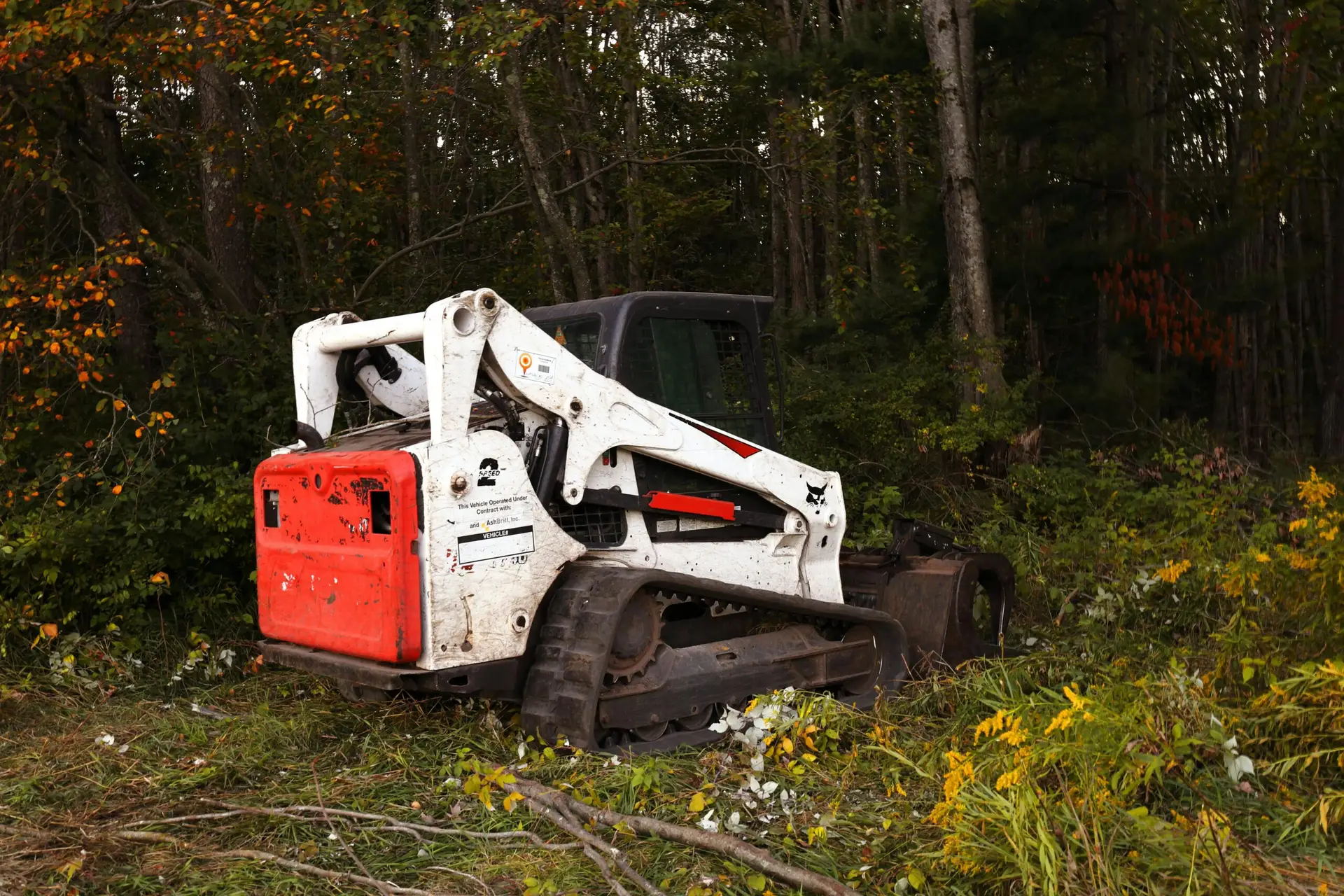
Most southeast Ohio land clearing jobs use one of three approaches: bulldozing and pushing debris into piles, traditional tree felling with hauling, or forestry mulching with a skid steer-mounted mulcher head.
Forestry mulching grinds trees, brush, and undergrowth into mulch right where it stands. There’s no burn pile, no hauling, and the mulch layer left behind helps hold soil in place while new ground cover establishes. For rolling, wooded southeast Ohio terrain, this is usually the more efficient option — fewer equipment passes, less disturbed soil, and a finished site that skips a separate cleanup phase. Many of the land clearing projects we handle end up relying on forestry mulching as the primary method, simply because it covers more ground with less disruption.
Pro Tip: Ask any land clearing contractor what happens to the debris before you hire them. If the answer involves a burn pile or a dump trailer, factor that extra time and cost into your decision. Mulching eliminates that step entirely.
Land Clearing in Southeast Ohio’s Terrain
Flat, open ground clears easily almost anywhere. Southeast Ohio rarely offers that. Rolling hills, creek-bottom lots, and dense second-growth woodland are the norm across Guernsey, Muskingum, Morgan, and Noble counties, and that terrain changes how a clearing job needs to be planned and executed.
Steep grades affect equipment access and increase erosion risk once vegetation is removed. Creek-bottom properties often sit close to waterways, bringing buffer zones and stormwater rules into play. Heavily wooded acreage left untouched for years often has invasive species like honeysuckle and autumn olive mixed in with desirable trees, which changes how the clearing pass needs to be approached.
A contractor working this region regularly learns to read these conditions before the first cut. Ben Kirkman, owner of Southeast Ohio Forestry Mulching, has been running heavy equipment since he was 14 years old, and that hands-on background shapes how each property gets assessed — not as a generic clearing job, but as a specific piece of southeast Ohio ground with its own slope, soil, and growth pattern. On properties where boundaries have grown over along with the rest of the lot, fence line clearing often gets handled in the same pass.
What Permits and Regulations Apply
This is the part of land clearing that catches landowners off guard. In Ohio, clearing land on your own residential property typically doesn’t require a state permit by itself. But once a project disturbs one acre or more of soil — including clearing combined with grading or excavating — state stormwater rules can apply.
Question: Do I need a permit to clear land in Ohio? Answer: Most small residential clearing projects don’t need a state permit. Projects disturbing one acre or more, especially those tied to construction, generally require coverage under Ohio’s construction stormwater general permit, along with an erosion and sediment control plan.
The Ohio EPA strongly recommends maintaining 50-foot buffers around surface waters, including wetlands, for any construction activity near them, and the agency’s erosion control practices require disturbed soil to stay covered unless an exception applies. You can review current thresholds and requirements directly through Ohio EPA’s construction stormwater general permit (OHC000006).
Beyond the state level, some Ohio counties and townships add their own tree preservation or setback rules, especially for land near streams or in flood-prone areas. The safest move is a quick call to your local building or zoning office before a larger project starts, since requirements shift by jurisdiction and by how much ground gets disturbed.
Did You Know? Standard land clearing guidance calls for keeping debris piles at least 100 feet from adjacent woodland, buildings, or roads — a detail many DIY clearing projects overlook until it becomes a fire or liability concern.
What Land Clearing Costs in Southeast Ohio
Pricing varies enough from property to property that exact numbers rarely hold up. What does hold steady are the factors driving the price up or down:
- Acreage and lot size. More ground means more time and fuel, even when the per-acre rate stays consistent.
- Tree density and vegetation type. A lot with scattered hardwoods clears faster than one choked with thick brush and invasive saplings.
- Terrain and slope. Steep or uneven ground slows equipment down and may call for extra erosion control once clearing finishes.
- Debris handling method. Mulching on site is usually more cost-effective than felling and hauling, since there’s no separate disposal step.
- Stump and root removal. Grinding stumps flush with the ground takes more time than leaving them in place, and that affects final cost.
Getting an apples-to-apples comparison means asking what’s actually included. A quote that mulches everything in place and handles stumps looks different from one that only fells trees and leaves the rest for you.
What Comes After Your Land Is Cleared
Clearing the land is rarely the final step. What happens next depends on the property’s goal, but a few things apply almost universally.
Freshly cleared ground is exposed soil, and exposed soil erodes fast, especially on slopes or near water. A mulching service leaves a layer that already provides a head start on erosion control, since it covers bare ground and slows runoff. Felling and hauling instead leaves bare dirt, which means a faster plan for ground cover through seeding, straw, or another stabilization method.
Pro Tip: If your project sits anywhere near a stream, pond, or wetland, get your erosion control plan in place before clearing starts, not after. Retrofitting protection on already-disturbed ground is harder and more expensive than building it in from day one.
From there, most properties move toward grading for drainage, soil testing for agriculture, or direct prep for a building pad. Each step connects back to how the clearing itself was handled, which is why the upfront approach matters as much as the work itself.
Frequently Asked Questions
What is the difference between land clearing and forestry mulching? Land clearing is the overall goal of removing vegetation to make land usable. Forestry mulching is one method for getting there, grinding trees and brush into mulch on site instead of hauling debris away.
How long does land clearing take on a typical southeast Ohio property? It depends on acreage, vegetation density, and terrain. A half-acre residential lot might take a day, while several wooded acres with dense undergrowth can take multiple days. A site walk-through gives the most accurate timeline.
Do I need a permit to clear land I own in Ohio? Usually not for small residential projects. Larger projects disturbing one acre or more, or those near waterways, typically require stormwater permitting and erosion control planning under Ohio EPA rules.
What happens to the trees and brush after clearing? With forestry mulching, vegetation is ground into mulch on site, leaving no debris to haul. Traditional clearing methods may involve burning, hauling, or stacking debris, depending on the contractor and local regulations.
Can stumps be removed during the clearing process? Yes. Forestry mulching equipment can often grind stumps down as part of the same pass, though very large or established stumps may need additional attention depending on size and root structure.
Land clearing changes what’s possible on a property, but it works best when it accounts for southeast Ohio’s terrain, the right equipment, and the regulations that apply once ground gets disturbed. Getting those pieces right from the start saves time, money, and erosion headaches down the road.
If you have land in Guernsey, Muskingum, Morgan, Noble, or a nearby southeast Ohio county that needs clearing, contact Southeast Ohio Forestry Mulching for a free, no-obligation site assessment. We’ll walk your property, talk through what it needs, and give you a straight answer on the work involved.