When a field, pasture, or stretch of rough terrain has gotten ahead of standard mowing equipment, a brush hog is what it takes to bring it back under control. Southeast Ohio Forestry Mulching provides brush hogging services for rural landowners and farmers throughout Cambridge and the surrounding counties — cutting down overgrown grass, weeds, briars, and light brush on fields and open terrain that standard rotary mowers can’t safely handle. Owner-operator Ben Kirkman serves the region from Cambridge, with a 60–80 mile service radius that covers southeast Ohio’s farming and rural communities. Our minimum job value is $1,500, and free on-site estimates are available Monday through Saturday, 7:00 AM to 5:00 PM. Call 844-685-4861 to schedule yours.
What Brush Hogging Actually Involves
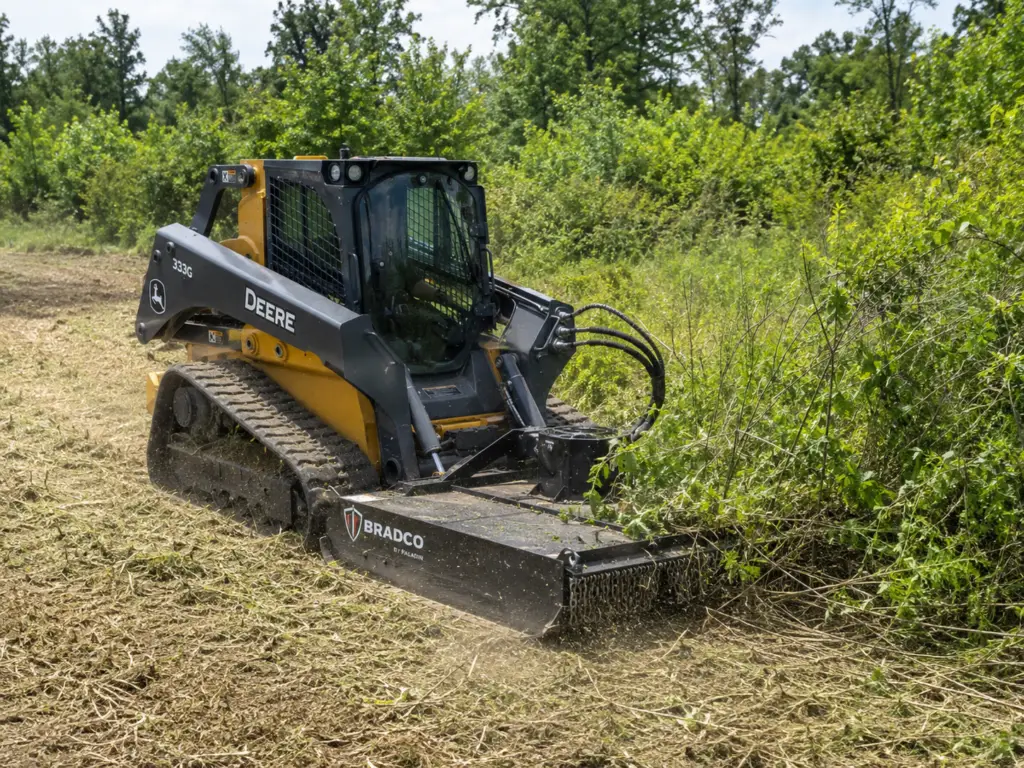
A brush hog — also called a rotary cutter — is a heavy-duty cutting attachment that handles vegetation a standard mower blade would destroy itself on: tall grass standing 3–4 feet high, dense weeds and briars, light woody brush, and rough ground with uneven terrain. The rotary drum’s free-swinging blades absorb impacts from hidden obstacles that would stop a standard deck mower cold. Brush hogging is not the same as forestry mulching — it’s designed for open fields and pastures where the primary growth is grass, weeds, and light brush, not trees and heavy timber. For overgrown fields that have lost a season or two to unmanaged growth, or for rough terrain edges along property lines and road frontage, brush hogging restores the ground to a manageable, accessible state. Cut material is left on the ground to decompose naturally — unlike forestry mulching, which grinds material into fine chips, brush hogging cuts and drops. For field and pasture applications, this is entirely appropriate, and the cut material breaks down over subsequent weeks without any additional management.
Our Brush Hogging Process
Step 1 — Site Assessment and Free Estimate
Ben walks the field or rough terrain area, noting growth density, any obstacles that need to be flagged or removed before cutting, and terrain conditions that affect how we approach the work. You get accurate pricing and a realistic picture of the result before we schedule.
Step 2 — Obstacle Identification and Pre-Clearing
Before the rotary cutter makes its first pass, we discuss any hidden obstacles — wire, debris, rocks, or equipment — that need to be flagged or removed. Cutting through hidden wire or solid debris damages equipment and creates safety hazards; we address that before it becomes a problem.
Step 3 — Systematic Brush Hog Passes
The rotary cutter works through the field or terrain area in overlapping passes, cutting vegetation down to a uniform height. Pass pattern depends on terrain shape and obstacle locations. For heavily overgrown areas, multiple passes at different cutting heights may be used to avoid overloading the cutter.
Step 4 — Edge and Border Work
Field edges, fence-adjacent areas, and rough terrain borders receive attention after the main cutting passes — working carefully around fence lines, drainage features, and any vegetation at the field’s perimeter that requires slower, more deliberate cutting.
Step 5 — Final Review
Ben walks the field with you at completion. The ground is accessible, the vegetation is cut back to a manageable state, and the field looks like what it should — usable land, not a brushy tangle. You’re back in control of the property.
Serving Cambridge and the Surrounding Region
We provide brush hogging throughout Guernsey, Muskingum, Morgan, Noble, and Coshocton counties, covering the farms, rural lots, and rough terrain parcels that are typical of southeast Ohio. Working farms and rural properties between Cambridge and Caldwell, along the Muskingum River corridor near Zanesville, and in the agricultural townships surrounding Senecaville and Byesville are regular project areas for us. If you’ve got a field that was hayed a few years ago and hasn’t been managed since, or a rough pasture edge that’s turned into a wall of multiflora rose and briar, brush hogging is exactly what it needs. Find out more about what we offer at southeastohiomulching.com.
Fields and pastures across southeast Ohio’s Appalachian foothills terrain face specific challenges: slopes that make standard tractor mowing hazardous, creek-adjacent low ground with dense reed grass and willow brush, and field edges that are two growing seasons from becoming full scrub. Our equipment and experience in this region means we’re not guessing about what works on southeast Ohio terrain — we’re applying the same approach weekly.
Why Southeast Ohio Landowners Choose Ben Kirkman for Brush Hogging
Brush hogging is one of those services where the quality of the result comes down to operator judgment — how aggressive to be on varying vegetation densities, when to slow down for rough terrain, where to start and end passes for the cleanest result. Because Ben operates the equipment himself on every job, that judgment is built in, not delegated. Learn more about how we work.
Frequently Asked Questions: Brush Hogging in Cambridge, OH
How is brush hogging different from forestry mulching?
Brush hogging uses a rotary cutter attachment for open-field grass, weeds, and light brush on fields and pastures. Forestry mulching uses a mulcher head with carbide teeth for heavier vegetation — trees, dense saplings, thick brush. If you’re unsure which applies to your property, describe what you’re dealing with and we’ll tell you which approach makes sense.
How often does brush hogging need to be done?
That depends on the property and what’s growing. Some landowners manage fields once or twice a year to keep growth controlled. Others come to us after several years of neglect. The right frequency depends on your goals for the land.
What should I do to prepare the field before you arrive?
Walk the area and flag or remove any hidden obstacles — wire, old fence remnants, debris, solid rocks — that could damage the equipment or create hazards. We discuss this during the estimate process so you know exactly what to check for.
Will brush hogging work on rough or uneven terrain?
It depends on the degree of slope and roughness. We assess the terrain during the estimate and let you know honestly whether our equipment can handle the conditions safely. Southeast Ohio terrain is not flat, and we’re accustomed to working in it — but every site has its own conditions.
What is your minimum job size for brush hogging?
Our minimum job value is $1,500. We’ll let you know during the estimate whether your project meets that threshold.
Related services: Fence Line Clearing | Forestry Mulching | Land Clearing