If trees and brush have taken over land you want back, forestry mulching is the most direct solution available — and Southeast Ohio Forestry Mulching is Cambridge’s owner-operated choice for getting it done right. Founder Ben Kirkman has been running heavy equipment since age 14, and every forestry mulching job comes with that same hands-on precision: a professional-grade skid steer with a forestry mulcher attachment that grinds trees, saplings, vines, and dense undergrowth into natural mulch on the spot. No burn piles. No debris hauling. No second trips to finish what should have been done the first time. From properties along near Cambridge to wooded hillsides throughout Guernsey, Muskingum, and Morgan counties, we clear the land that matters to you. Call us at 844-685-4861 for a free estimate.
What Forestry Mulching Actually Involves
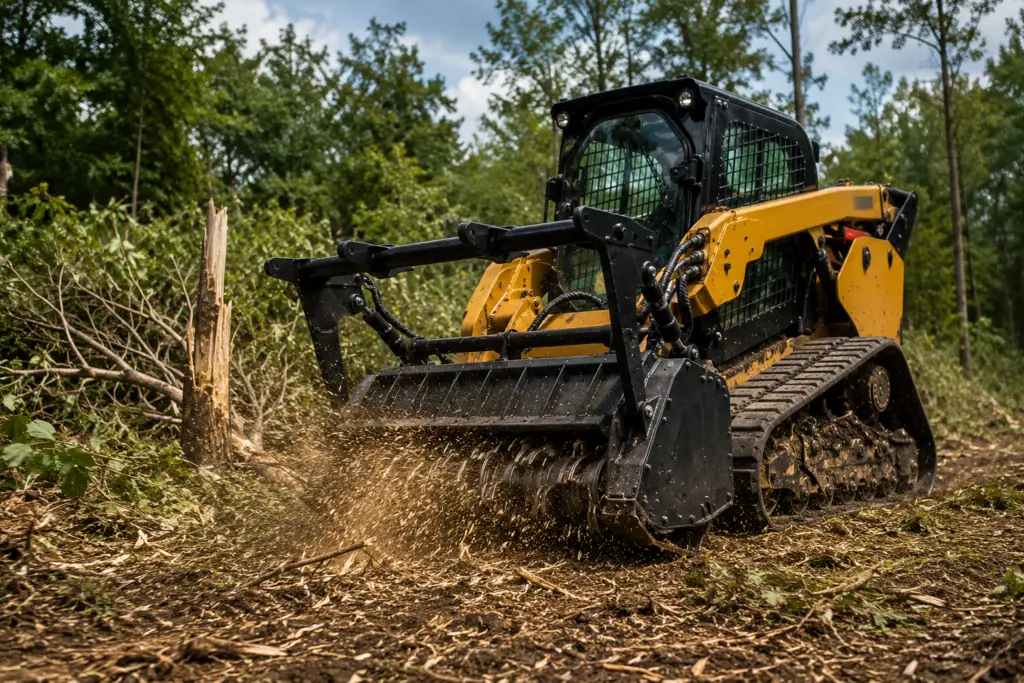
Forestry mulching is a land clearing method that uses a skid steer fitted with a heavy-duty rotary drum — the mulcher head — packed with carbide teeth. Those teeth spin at high speed, shredding trees, saplings, thick vines, and undergrowth into small chips that settle back onto the soil surface. Before the mulcher arrives, your land looks like a wall of vegetation: overgrown pasture edges, wooded lots where you can’t see the ground, fence lines buried in brush. After a single systematic pass, the surface is flat, the material is processed, and the organic mulch layer left behind actually improves the soil — reducing erosion, retaining moisture, and adding organic matter as it breaks down. The USDA notes that mulch conserves water, suppresses weeds, and protects soil from erosion, which means forestry mulching isn’t just clearing — it’s actively improving the ground it covers. Because everything is processed on site, there are no burn permits to pull, no hauling logistics to coordinate, and no debris piles left for you to manage afterward. The process works efficiently on a wide spectrum of vegetation — from light scrub and saplings to established trees — and the skid steer’s compact footprint minimizes ground disturbance compared to larger dozer-based clearing equipment.
Our Forestry Mulching Process
Step 1 — Property Walk and Free Estimate
Ben walks your property before any equipment is unloaded, identifying the vegetation type and density, any obstacles around structures or fences, and terrain conditions that shape the approach. You receive a clear scope of work and honest pricing — no vague numbers, no pressure.
Step 2 — Equipment Staging and Site Assessment
Our skid steer and forestry mulcher attachment are trailered to your site and staged for access. We confirm the clearing boundaries with you before the first pass begins, so there are no surprises about what will and will not be touched.
Step 3 — Systematic Mulching Pass
The mulcher head works through the vegetation in overlapping passes, starting from the perimeter or a designated entry point. Carbide teeth on the rotary drum cut through everything from light brush to trees, grinding material into chips that drop back to the ground surface. The skid steer’s maneuverability allows us to work around retained trees, fence lines, or structures as specified.
Step 4 — Ground Surface Check and Stump Processing
Following the main clearing pass, we make a detail pass to address any remaining stumps or material the mulcher can bring down closer to grade. In most cases, the mulcher processes stumps as part of the primary pass — grinding them rather than leaving them standing or requiring a separate stump grinder.
Step 5 — Final Walkthrough and Customer Handoff
Ben walks the cleared area with you to confirm it meets the agreed scope. You see the mulch layer in place, the cleared ground surface, and the result of a job done in a single mobilization. No return trips, no staging areas left behind — just the property you hired us to clear.
Serving Cambridge and the Surrounding Area
Southeast Ohio Forestry Mulching operates out of Cambridge — at the crossroads of Guernsey County — and covers a 60–80 mile radius that takes in the full range of rural and residential land this region offers. We regularly work properties near Salt Fork State Park and Seneca Lake, where wooded hillsides and creek-adjacent land are common clearing challenges. Our crews reach throughout Muskingum, Morgan, Noble, and Coshocton counties, as well as south toward Marietta and west toward the outer Columbus corridor. Whether you’re on a rural acreage off US-40 (the National Road) or a wooded residential lot near Byesville, Caldwell, or Zanesville, we can be there. Visit our homepage to learn more about our full service area.
The hilly, forested terrain of Guernsey County and the surrounding Appalachian foothills creates land clearing challenges that flat-ground operators aren’t prepared for. Wooded slopes, dense hardwood stands, and overgrown creek bottoms are standard on southeast Ohio properties — and they’re exactly the conditions our skid steer handles well. The compact machine footprint preserves soil structure on sloped terrain far better than dozer-based alternatives, and the mulching process eliminates the staging areas that burn-and-haul methods require.
Why Cambridge Landowners Choose Southeast Ohio Forestry Mulching
Ben Kirkman founded Southeast Ohio Forestry Mulching to give landowners in this region something straightforward: a capable owner-operator who shows up when he says he will and gets the work done without shortcuts. There is no crew of rotating subcontractors — when you call 844-685-4861, you speak directly with the person who will run your job. Learn more about Ben and how we work.
Our primary equipment — a professional-grade skid steer with a forestry mulcher head fitted with carbide teeth — is purpose-built for this work, not a repurposed machine pressed into service. That matters on southeast Ohio properties where vegetation density, terrain variation, and property-specific constraints demand equipment that performs reliably under real conditions. Free estimates are available Monday through Saturday, 7:00 AM to 5:00 PM, and we give you a realistic picture of scope and timing before any work begins. For additional context on forestry mulching as a land management practice, the Ohio Department of Natural Resources publishes best-practice guidance for vegetation management on rural properties at ohiodnr.gov.
Frequently Asked Questions: Forestry Mulching in Cambridge, OH
What size trees can a forestry mulcher handle on a southeast Ohio property?
The mulcher head on our skid steer is designed for professional land clearing, handling a significant range of tree diameters. Practical limits depend on species density and site conditions — hardwoods like oak and hickory that are common across Guernsey County present different demands than softer-wooded saplings. Ben assesses the timber during the site walk and gives you an honest read on what the equipment can achieve on your specific property.
Will forestry mulching damage my ground or leave a mess?
No significant ground damage results from the process under normal conditions. The mulch layer left behind actually protects and improves the soil — reducing erosion, retaining moisture, and adding organic matter as it decomposes. The skid steer’s compact footprint causes far less ground disturbance than dozer-based clearing. Some surface tracking may occur in wet conditions, which we discuss during the estimate.
Do I need a burn permit or debris removal after forestry mulching?
Neither. Forestry mulching is a self-contained process — all vegetation is ground on site and left as mulch. There is no burning, no hauling, and no return trips to clean up debris. That is one of the core advantages of the method versus traditional clearing approaches.
How much does forestry mulching cost in Cambridge, Ohio?
Pricing is based on acreage, vegetation density, terrain conditions, and site access. Our minimum job value is $1,500. Because every property is different, we offer free on-site estimates so you know the exact cost before any commitment. Call 844-685-4861 to schedule yours.
How long does a forestry mulching job take?
A smaller residential lot may be completed in a single day. Larger acreage with dense vegetation and challenging terrain takes longer. We provide a realistic timeline during the estimate based on what we see on your property — not a generic range.
Can forestry mulching be done on the sloped terrain common in Guernsey County?
Yes. Our skid steer is suited for varied terrain, including the rolling hillsides and grade changes that are standard across southeast Ohio properties. We assess slope conditions and any access limitations before committing to work on a given site.
Related services: Land Clearing | Fence Line Clearing | Trail Cutting